Sorry prospectives

a crying face animated gif.  From wikipedia public domain.

This year the quantum condensed matter theory group — myself, Matthew Fisher, Cenke Xu, Sagar Vijay, and Andreas Ludwig — will not be considering admitting new graduate students to UCSB Physics this cycle, i.e. for admission in Fall 2026. This is because we are currently at our advising capacity and want to be conservative given the uncertainties related to federal support of research. Students who do apply and list condensed matter theory as their primary interest will still have their applications read, but they will be considered by faculty for other groups based on the prospects in other fields.

This is a temporary situation and we fully expect to admit graduate students for the Fall of 2027.

Time to get back to business

It’s been too long since I last wrote. What can I say – 2020! I hope to get back to more regular posts, and mostly focus on physics. What’s new since the last time I wrote?

My group has written a few papers:

  • Dynamical signatures of quasiparticle interactions in quantum spin chains – With Anna Keselman and Oleg Starykh, we managed to uncover some unappreciated physics in one dimensional Heisenberg antiferromagnetic chains. These are some of the most iconic and heavily studied models in theoretical physics, so it’s surprising to find anything new in them! Yet it turns out there are some beautiful lessons to be learned here about interactions between quasiparticles.
  • Hybrid Wannier Chern bands in magic angle twisted bilayer graphene and the quantized anomalous Hall effect – With my student Kasra Hejazi and former postdoc Xiao Chen. We (really mostly Kasra!) reformulated the now-famous continuum model for twisted bilayer graphene in terms of hybrid Wannier states, which circumvents all topological obstructions, and helps to make Chern number physics more transparent.
  • Heterobilayer moiré magnets: moiré skyrmions, commensurate-incommensurate transition and more – This is actually our (Kasra Hejazi, Zhu-Xi Luo and myself) second paper on physics arising from moiré patterns in magnetic two dimensional materials. Here we wanted to see how the length scales of moiré patterns interact with those of spiral magnetism and skyrmions in non-centrosymmetric magnets. It could be a powerful way of manipulating the latter.
  • Frustrated Heisenberg J1J2 model within the stretched diamond lattice of LiYbO2: This is a collaboration with Stephen Wilson’s experimental group in the UCSB materials department. His student Mitchell Bordelon spearheaded this project, uncovering an interesting rare earth effective spin-1/2 antiferromagnet. My student Chunxiao Liu took the reins on the theory side and came up with a rather appealing simple model which explains most (but not all – it’s probably better to keep some mystery in the world) of the main features of Mitchell’s experiments. For the experts, the story places this compound close to the competing exchange models for “spiral spin liquids” studied for the honeycomb and diamond lattices.

Apart from these papers, of course there are more in the works, and I am really hoping to finish a few in particular that have been in the pipeline for months to years in some cases (hopefully the best papers are like fine wine and need some time to mature). We’ve been running virtual group meetings, and we have a new crop of KITP graduate fellows for fall who are attending virtually. Some new KITP postdocs in condensed matter have arrived: Wenjie Ji and Jong Yeon Lee are here in Santa Barbara and Urban Seifert is at least part-time here in spirit, while enjoying an intermediate-term position with Lucile Savary’s group at ENS Lyon. The KITP’s new Correlated program has started, and that’s been a fun meeting twice a week (but unfortunately we have to start at 8am PST to keep the Europeans in the loop Zoom/pandemic style) – great job finding interesting speakers Natasha, Lucile, George and Oskar! KITP has also tried a new initiative: short virtual conferences organized by KITP postdocs. The one last week organized by Urban Seifert and Zhu-Xi Luo was excellent!

I’ve started teaching for the fall, of course virtually – doing the first quarter of graduate condensed matter physics, i.e. solid state physics, bands, phonons, transport, etc. Virtual teaching is its own experience. Going full gaucho – I’m uploading my hand-written ipad notes from class to UCSB’s Gauchospace, and recordings of the video of the lectures to UCSB’s Gauchocast. It’s not clear where my students are. I do know that one of them is in Kazakhstan – perhaps not the most obvious place to try to get a US visa, but apparently that’s the place for this fellow. Poor guy is tuning into my lecture at midnight his time… Anyway, I’m trying/hoping to present an “updated classic” take on it, and writing my own latex lecture notes along the way. I spent quite some time learning more about Thomas-Fermi theory and figuring out how to present some of that. Now I’m on to more conventional material and it’s certainly easier going.

And today I got confirmation of receipt of my 2020 ballot:

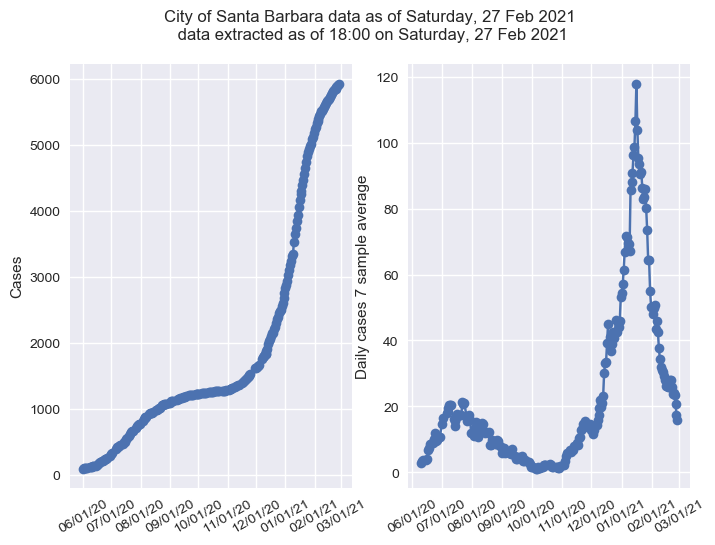
COVID-19 in the city of Santa Barbara

I can’t help being a little obsessive about the coronavirus situation in our little town of Santa Barbara. One can find a lot of data at the county level in the California state web sites, but broken down by city I could find it only in the County web page and not in a form that was quite what I wanted. So I wrote a little python script that extracts the data from the county web page, and creates plots of the total cases in the City of Santa Barbara, as well as a 7-day average of new cases reported (it is an average over the last 7 days of reports, not over a fixed week range, but that is because the county does not report every day).

The original data is here: https://publichealthsbc.org/status-reports/

I’ve automated this so that the plots automatically update daily. Be aware that this is just an amateur project, and there could be errors, for example if the County changes its format for displaying the data. This was a little bit of a fun project to do. I wrote a python script to extract the data from the county page and create the plots. Then a shell script uses git to upload the plot to github, and the web page has an embedded image link to the plot in the github repository. The shell script runs daily on my mac laptop using launchd. All the code (except the launchd xml file) is on github here: https://github.com/balents/covidSB .

#ShutDownAcademia

I followed the #ShutDownAcademia action Wednesday, as many of my colleagues did. The unfortunate truth is that there are very few Black academic physicists. Despite traveling extensively to conferences and working at the KITP, where we have a huge influx of visitors, I have met only a handful in more than 25 years of my academic career. I sincerely hope that changes, and people like me need to do our part to make it possible.

I came across some fascinating discussions of the situation from arguably the most famous physicist, Albert Einstein. I could not track down the original sources, but there are some good online articles here and here. In an address at Lincoln University, a predominantly black university in Pennsylvania, Einstein reported said “There is a separation of colored people from white people in the United States. That separation is not a disease of colored people. It is a disease of white people. I do not intend to be quiet about it.” Einstein’s activism on the subject was not known to me, but is yet another aspect of his life that inspires.

Something that my daughter and I have been doing in the last few weeks (with no causal connection to recent events) has been to try to learn about Africa, is countries, cultures, and geography. We found an engaging series of videos on YouTube called GeographyNow, which posts 10-15 minute summaries of the countries of the world. We’ve been going through African nations one by one, and while this is not the most academic format but it is fun and both of us find it fascinating and have been impressed by the richness and cultural diversity of the continent and its peoples.

This is not the most coherent thread, but I wanted to write something. There is really no way for a privileged person like myself to do this topic justice. I just wanted to show that the injustice of the Black condition in this country is deeply felt, and that I believe it is relevant to us in physics. By improving diversity in the field, we will enrich it and I am sure improve the science.

Virtual talk

I’ll be doing my first virtual seminar this week. I was scheduled to visit the Flatiron institute in NYC this week, and obviously that was not going to happen, so I’ll be giving the talk from the comfort of my dining table 🙂

The talk is Tuesday 12pm east coast time, so 9am for me. I’ll be talking about some recent and on-going work in which Oleg Starykh, Anna Keselman and I study how you can observe *interactions* between quasiparticles in quantum magnets from the dynamical structure factor.

Here is a link:

Virtual Quantum Cafe: Leon Balents

and yes…they quite systematically mis-spelled my name!

Why come to UCSB?

This is the season in which students are deciding where to go for graduate school in the US. Around the country, students have been admitted to PhD programs, passing through a remarkably selective filter. To give you an idea, we typically get something like 600-700 applicants for what we hope will be 20-30 incoming students in all fields of physics. It’s a tough competition, and those that make it are a talented bunch. After that, the shoe is on the other foot. These students invariably have multiple offers, and now *they* have to choose where to go. The deadline to respond to our offer is generally tax day, April 15 (and as far as I know this is pretty much true everywhere). So we’re getting close.

Normally physics departments invite these “prospective” students to a day-long visit of the campus, to meet professors and students, and learn more about the program. With COVID-19, we like many others canceled the visit, which would have been yesterday, and held instead a virtual visit. I spent 4.5 hours yesterday on Zoom with prospectives. It worked pretty well but I can’t help but wonder what got lost in the mix. For example, we normally hold a poster session with current students showing their work to the prospectives, there are casual events to discuss, etc. It all was pretty compressed and intensified by the last-minute change to virtual space.

So…I thought maybe it would be useful to give a few advertisements for UCSB physics, focusing on condensed matter because well that’s what I know best.

  • We’ve got a big and top-notch condensed matter theory effort. Apart from myself, there are five physics faculty working in quantum matter theory: Matthew Fisher, Chetan Nayak, Cenke Xu, Andreas Ludwig, and starting this fall Sagar Vijay. But that’s not all. Microsoft Quantum has several permanent scientists that advise students: Bela Bauer, Roman Lutchyn, Parsa Bonderson. There are a number of computational theorists in other departments: Chris van der Walle, Vojtech Vlcek, Glenn Fredrickson (Glenn does polymer physics, which is classical not quantum, but recently his group has discovered they can use their polymer algorithms to simulate quantum spins or bosons!). We also have a number of theorists in soft and living matter, which isn’t quantum but neverthess we share a lot of ideas in common: Boris Shraiman, Cristina Marchetti (Cristina and I go way back – we collaborated back in the 90s!), Mark Bowick. There’s also some convergence of interest with the string/gravity group, where chaos and scrambling, SYK models, etc. are being actively studied.
  • Don’t forget our postdocs! The KITP has a track record of hosting the best postdocs in the world, and it hasn’t changed. They are young, motivated, and brilliant, and they are eager to work with our students. Typically we have about a half dozen overall in condensed matter and quantum information.
  • More is different: Probably the most unique feature of UCSB is all the collaborative opportunities.
    • In theoretical physics at the center is the KITP: take a look here to see the 16 programs already scheduled for the next 1.5 years. Each one will bring 20-30 world-class scientists *every week* to the KITP to present their research, discuss ideas, and start new collaborations. It’s an amazing opportunity for our students to learn new things and gain valuable exposure.
    • There’s Microsoft Quantum, which is next door to the KITP and 5 minutes from the Physics department.
    • The new UCSB Quantum Foundry is an NSF sponsored center aimed to develop the quantum materials needed for quantum information science. I am part of “Thrust 1” whose goal is to study highly entangled matter such as spin liquids and topological superconductors. The Foundry offers collaborations, seminars, fellowships and more for students.
    • I am the co-director of the international program on Quantum Materials run through CIFAR. It’s a collaborative network of currently 15 scientists (theorists, experimentalists, and sample growers) from around the world interested in the deepest questions in the field. We meet a couple of times a year with students and postdocs and visitors to discuss and chart new research directions.
    • UCSB is a member of the Simons Collaboration on Ultra-Quantum Matter, which combines condensed matter, quantum information, atomic, and string theorists to study the nature of highly entangled and quantum critical matter. The Collaboration holds schools and meetings, and encourages exchanges of members.
    • We are an EPiQS Theory Center sponsored by the Moore Foundation. This supports some of those great postdocs and beyond.
  • That’s not all – I just got tired to typing. There are even more collaborations and multi-university efforts that students can become a part of.
  • It all connects to experiment: My personal favorite part of the field is connecting to real-world measurements in the lab. I have a lot of friends at UCSB who make those measurements. Stephen Wilson in materials grows new materials all the time, and we’ve been collaborating constantly on quantum magnets, spin liquids, Mott insulators, and superconductors. Susanne Stemmer is one of the top thin film (MBE) growers in the world, and has made many advances in correlated and topological materials. Andrea Young‘s lab is bursting with new discoveries in 2d materials such as twisted bilayer graphene, which provides a rich source of phenomena for theory to tackle. We keep hiring great young experimentalists in both the physics and materials departments, in both condensed matter and amo physics, and beyond this networks such as CIFAR and EPiQS, MURI grants, and more give students even more access to exciting experiments — and arguably I am pretty good at teaching them how to connect these with theory.
  • Our students are successful. The vast majority of the condensed matter theory group’s students stay in academia, and find permanent research positions.
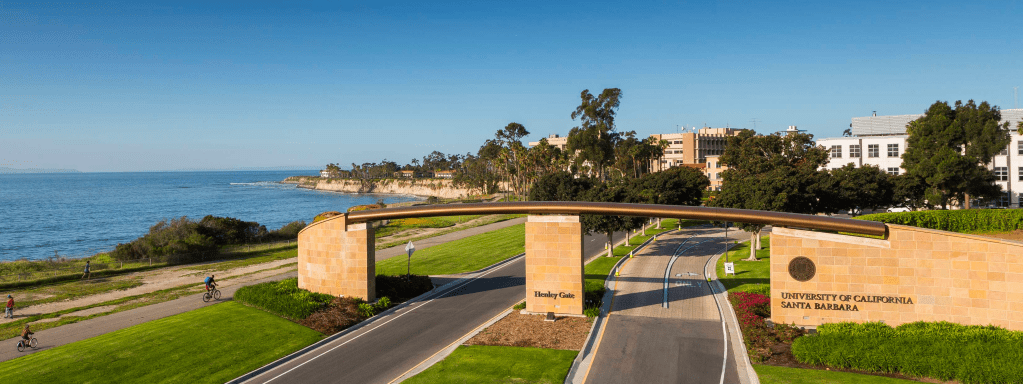
and it’s not so bad to come to this every day!

Benefits of teaching

I taught this August in a summer school in Cargèse, Corsica, which is an island in the Mediterranean that is part of France. It was an especially fun trip for me as I attended a school at the same location in 1993, as a graduate student. Other students there with me were Leo Radzihovsky, Ali Yazdani, Katherine Moler, and Dan Dessau, to name a few that come immediately to mind. They all did rather well in physics since!

Anyway, I decided to lecture about twisted bilayer graphene (TBG), which was a bit of an undertaking – I gave 6 hours of lectures over 4 days. You can find my hand-written lecture notes on this site (under pedagogy), and I’m working on a latex version (I have them for 3 out of four of the 1.5 hour lectures).

I already benefited myself from the class, because it motivated me to finally work out an old idea I had. This is a derivation of the “continuum model” of Bistritzer and MacDonald (BM), which is what really started the whole TBG discovery by predicting the presence of “magic angles”. Their work is really nice, and many others have since used their formulation to elaborate or extend the treatment in many ways. I always felt though that the derivation in BM’s paper was not so intuitive, and the final result – the continuum model – is simpler than the way it was obtained. Specifically it just seems to capture the idea that locally TBG just “looks” like an untwisted bilayer with some relative shift between layers. I had the idea after reading their paper that one could derive the continuum model by turning that idea into a calculation.

There is some subtlety related to the difference between Eulerian and Lagrangian coordinate systems which stymied me initially. But since I had to teach the stuff I was motivated to spend the time and I was able to overcome that issue. The result is so simple it borders on trivial, but I like the simplicity of it. Maybe it makes the problem a bit more accessible to some people. You can read about it here: https://arxiv.org/abs/1909.01545.